Employee IDs for AI Agents? How Korea’s Biggest Companies Are Rethinking Work in 2026
August 31, 2026
Artificial intelligence is already helping office workers write emails, summarize documents and analyze data.
But some South Korean companies are beginning to experiment with something more unusual.
Instead of treating AI only as software, they are beginning to organize AI agents more like members of a workplace.
A report published on August 31, 2026 highlights a growing trend among major Korean companies: AI agents are being integrated into corporate organizations with defined roles, responsibilities and, in some cases, even employee-style identification.
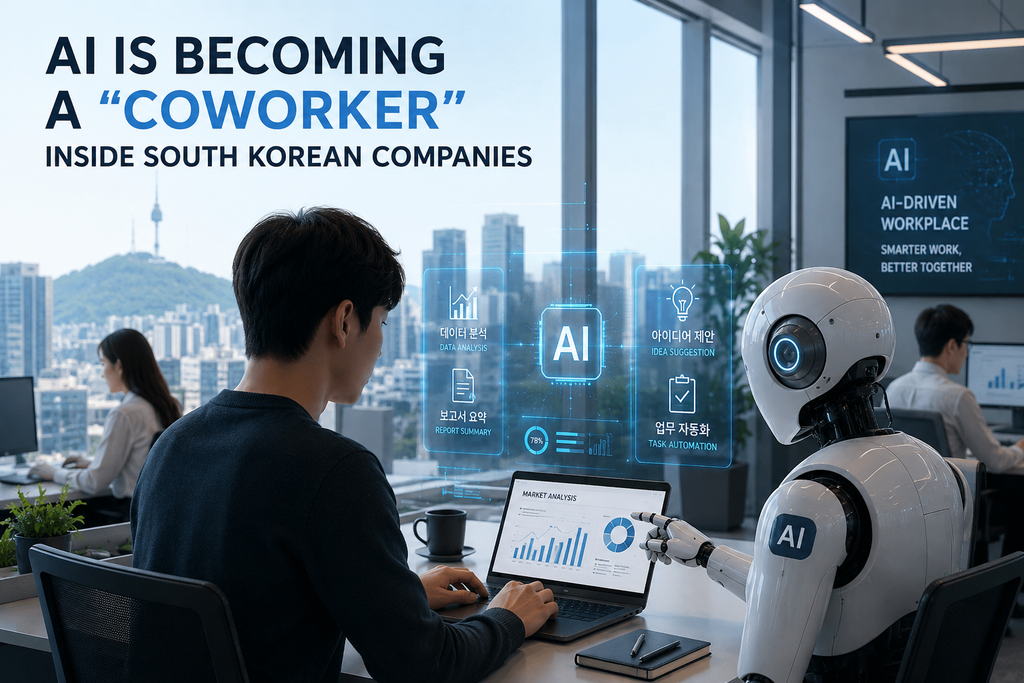
🤖 From AI Tool to AI “Employee”
For years, companies have mainly used generative AI as an assistant.
Employees asked a question, and AI produced an answer.
Agentic AI is changing that model.
An AI agent can potentially receive a goal, perform several steps, use approved company systems and return a completed result.
SK Telecom officially announced in June that its AX Innovation 2.0 strategy would treat AI agents as new work agents rather than simple productivity tools.
🪪 Yes, Some AI Agents Are Getting Employee IDs
This is probably the most eye-catching part of Korea’s experiment.
[확실] Under SK Telecom’s plan, AI agents can receive employee identification numbers, organizational affiliations, job functions and access permissions. The company says the agents will be managed through a governance system covering areas such as data and security access.
That doesn’t mean an AI has legally become a human employee.
The employee ID is essentially an organizational-management mechanism.
But symbolically, it shows how quickly the role of enterprise AI is changing.
👩💻 One Human Could Work With Several AI Agents
SK Telecom says its internal experiments have explored a multi-role work style, where one employee can work across planning, development and design with several AI agents.
The company says its pilot work indicated potential for shorter planning time and faster decision-making.
[추정] If this model expands, the future office may look less like “one employee using one AI chatbot” and more like “one employee managing a small team of specialized AI agents.”
🏢 AI Adoption Is Spreading Beyond Telecom
This change isn’t limited to one Korean technology company.
Korean companies in finance, electronics and other industries have also been expanding workplace AI tools and internal AI agents during 2026.
For example, Hanwha Life reported that employees submitted about 150,000 prompts during its AI adoption period and created roughly 1,200 AI agents. The company said 54.5% of employees used Copilot in actual work during the adaptation period.
This gives us an important clue about where enterprise AI may be heading.
Companies aren’t only buying one general-purpose chatbot anymore.
They are increasingly creating specialized agents for specific workflows.
📄 What Kind of Work Can AI Agents Do?
Current Korean corporate examples include document drafting, report organization, form completion, internal communication and other repetitive office workflows.
Other agents can be designed for specialized tasks.
Hanwha Life says it is developing AI models for insurance-related work including product development, risk-rate calculations and profitability management.
[추정] The biggest productivity gains may eventually come not from asking AI more questions, but from allowing approved AI agents to complete entire workflows under human supervision.
🔐 What About Security?
Giving an AI access to company systems creates an obvious question.
How do companies stop an AI agent from accessing information it shouldn’t see?
SK Telecom says its AI-agent framework includes governance for data access and security permissions, and the company is also upgrading internal security systems as it expands AI use.
This is a crucial distinction between consumer AI and enterprise AI.
A company needs to know what an agent can access, what actions it can perform and who is responsible for reviewing the result.
💼 Does This Mean AI Will Replace Korean Workers?
The available corporate announcements do not establish that these AI-agent programs will simply replace human employees. SK Telecom describes its model as humans and AI working as a team, with repetitive tasks shifted toward AI so employees can focus more on creative and strategic work.
Even so, widespread AI-agent adoption is likely to change the skills companies value.
Knowing how to define a task, verify AI output, protect sensitive data and manage automated workflows may become increasingly valuable workplace skills.
🌏 Why Korea Is Worth Watching
South Korea is already a major global player in semiconductors, electronics, telecommunications and digital services.
Now it is also experimenting with how AI agents fit inside actual corporate organizations.
This comes as Korea is simultaneously increasing investment in national AI infrastructure and domestic AI services. The government selected three major consortiums for its nationwide AI initiative on August 28.
Together, these developments make Korea an interesting real-world test case for a larger global question: what happens when AI moves from being an app employees open to becoming an active participant in how an organization works?
Korean Word of the Day
동료
dong-nyo
→ coworker / colleague
직장 동료
jik-jang dong-nyo
→ workplace colleague
Example:
AI와 함께 일하는 직장인이 늘고 있어요.
e-i-a-i-wa ham-kke il-ha-neun jik-jang-in-i neul-go i-sseo-yo.
→ More office workers are working with AI.
✨ Korean Now — Quick Take
Some Korean companies are organizing AI agents as workplace participants rather than simple software tools.
SK Telecom’s model includes employee IDs, roles, affiliations and access permissions for AI agents.
Hanwha Life employees created around 1,200 AI agents during its workplace AI rollout.
The next phase of workplace AI may be less about chatting with AI and more about managing teams of specialized agents.