Hi, I’m Ayla! 👋
Welcome back to Simply Korea 101!
Today, we’re going to learn how to ask for and understand directions in Korean.
When you’re traveling in Korea, you may need to find a subway station, restroom, café, hotel, or bus stop.
Knowing just a few simple expressions can make getting around Korea much easier.
Let’s get started!
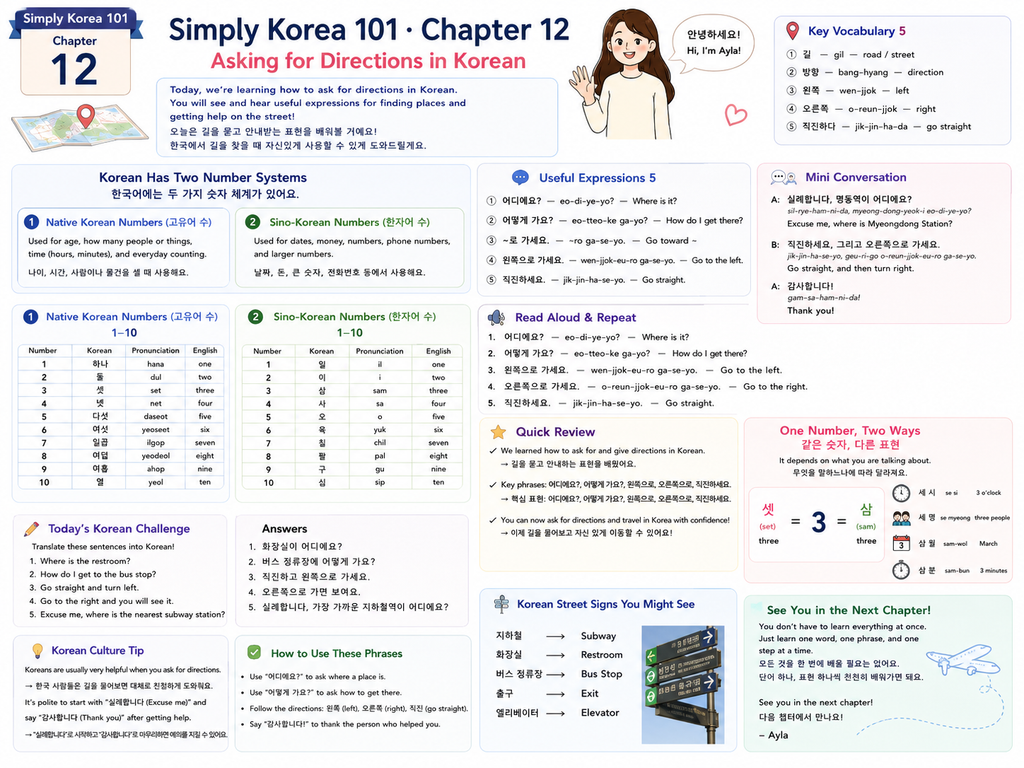
📍 Key Vocabulary 5
Let’s begin with five useful words for asking and giving directions.
① 길 — gil — road / street / way
② 방향 — bang-hyang — direction
③ 왼쪽 — wen-jjok — left
④ 오른쪽 — o-reun-jjok — right
⑤ 직진하다 — jik-jin-ha-da — to go straight
Try saying 왼쪽 and 오른쪽 a few times.
You’ll hear these two words often when someone gives you directions.
🗺️ Useful Expressions 5
① 어디예요?
어디예요?
eo-di-ye-yo?
→ Where is it?
This is one of the easiest ways to ask where something is.
화장실이 어디예요?
hwa-jang-sil-i eo-di-ye-yo?
→ Where is the restroom?
② 어떻게 가요?
어떻게 가요?
eo-tteo-ke ga-yo?
→ How do I get there?
Use this when you want to know how to reach a place.
명동역에 어떻게 가요?
myeong-dong-yeok-e eo-tteo-ke ga-yo?
→ How do I get to Myeongdong Station?
③ ~로 가세요.
~로 가세요.
~ro ga-se-yo.
→ Go toward ~ / Go to ~
You’ll often hear 가세요 when someone is explaining directions.
④ 왼쪽으로 가세요.
왼쪽으로 가세요.
wen-jjok-eu-ro ga-se-yo.
→ Go to the left.
And for the opposite direction:
오른쪽으로 가세요.
o-reun-jjok-eu-ro ga-se-yo.
→ Go to the right.
⑤ 직진하세요.
직진하세요.
jik-jin-ha-se-yo.
→ Go straight.
This is another expression you’ll hear very often in Korea.
🏙️ Useful Place Words
Here are a few place names that are useful when asking for directions.
지하철역 — ji-ha-cheol-yeok — subway station
버스 정류장 — beo-seu jeong-nyu-jang — bus stop
화장실 — hwa-jang-sil — restroom
편의점 — pyeon-ui-jeom — convenience store
호텔 — ho-tel — hotel
Now you can combine them with 어디예요?
지하철역이 어디예요?
ji-ha-cheol-yeok-i eo-di-ye-yo?
→ Where is the subway station?
편의점이 어디예요?
pyeon-ui-jeom-i eo-di-ye-yo?
→ Where is the convenience store?
🗣️ Mini Conversation
Asking for Directions
A: 실례합니다. 명동역이 어디예요?
sil-lye-ham-ni-da. myeong-dong-yeok-i eo-di-ye-yo?
→ Excuse me. Where is Myeongdong Station?
B: 직진하세요. 그리고 오른쪽으로 가세요.
jik-jin-ha-se-yo. geu-ri-go o-reun-jjok-eu-ro ga-se-yo.
→ Go straight. Then turn right.
A: 여기에서 멀어요?
yeo-gi-e-seo meo-reo-yo?
→ Is it far from here?
B: 아니요, 가까워요.
a-ni-yo, ga-kka-wo-yo.
→ No, it’s close.
A: 감사합니다!
gam-sa-ham-ni-da!
→ Thank you!
Knowing 실례합니다 is also useful when approaching someone you don’t know.
실례합니다 — sil-lye-ham-ni-da — Excuse me
It makes your question sound more polite.
🔊 Read Aloud & Repeat
Let’s practice today’s expressions aloud.
어디예요?
eo-di-ye-yo?
→ Where is it?
어떻게 가요?
eo-tteo-ke ga-yo?
→ How do I get there?
왼쪽으로 가세요.
wen-jjok-eu-ro ga-se-yo.
→ Go to the left.
오른쪽으로 가세요.
o-reun-jjok-eu-ro ga-se-yo.
→ Go to the right.
직진하세요.
jik-jin-ha-se-yo.
→ Go straight.
Now try saying them without looking at the English meaning.
🎯 Today’s Korean Challenge
Translate these sentences into Korean.
1. Where is the restroom?
→ __________
2. How do I get to the bus stop?
→ __________
3. Go straight and turn left.
→ __________
4. Go to the right and you will see it.
→ __________
5. Excuse me, where is the nearest subway station?
→ __________
Answers
1. 화장실이 어디예요?
hwa-jang-sil-i eo-di-ye-yo?
→ Where is the restroom?
2. 버스 정류장에 어떻게 가요?
beo-seu jeong-nyu-jang-e eo-tteo-ke ga-yo?
→ How do I get to the bus stop?
3. 직진하고 왼쪽으로 가세요.
jik-jin-ha-go wen-jjok-eu-ro ga-se-yo.
→ Go straight and then go left.
4. 오른쪽으로 가면 보여요.
o-reun-jjok-eu-ro ga-myeon bo-yeo-yo.
→ Go to the right and you’ll see it.
5. 실례합니다. 가장 가까운 지하철역이 어디예요?
sil-lye-ham-ni-da. ga-jang ga-kka-un ji-ha-cheol-yeok-i eo-di-ye-yo?
→ Excuse me. Where is the nearest subway station?
How many could you say without checking the answers?
Korean Culture & Usage Tip
When asking a stranger for directions in Korea, starting with 실례합니다 is a polite choice.
You can finish the conversation with 감사합니다.
감사합니다 — gam-sa-ham-ni-da — Thank you
Even if your Korean isn’t perfect, these simple polite expressions can make communication much smoother.
✨ Quick Review
Today, we learned how to ask for and understand simple directions in Korean.
Remember these key expressions:
어디예요? — eo-di-ye-yo? — Where is it?
어떻게 가요? — eo-tteo-ke ga-yo? — How do I get there?
왼쪽 — wen-jjok — left
오른쪽 — o-reun-jjok — right
직진하세요 — jik-jin-ha-se-yo — Go straight
The next time you’re in Korea, try asking for directions in Korean!
💛 See You in the Next Chapter!
You don’t have to learn everything at once. Just learn one word, one phrase, and one step at a time.
Keep practicing, and you’ll be surprised how much Korean you can understand.
See you in the next chapter!
— Ayla
Let’s discover Korea, one word, one dish, and one story at a time.