Hi, I’m Ayla! 👋
Welcome back to Simply Korea 101!
In Chapter 10, we learned that Korean has two number systems: Native Korean numbers and Sino-Korean numbers.
Today, we’re going to use those numbers in one of the most useful situations in Korea: money!
Korea’s currency is called the won (원), and Sino-Korean numbers are used when talking about prices and money.
By the end of today’s lesson, you’ll be able to recognize Korean coins and banknotes, read common prices, and ask how much something costs.
Let’s get started!
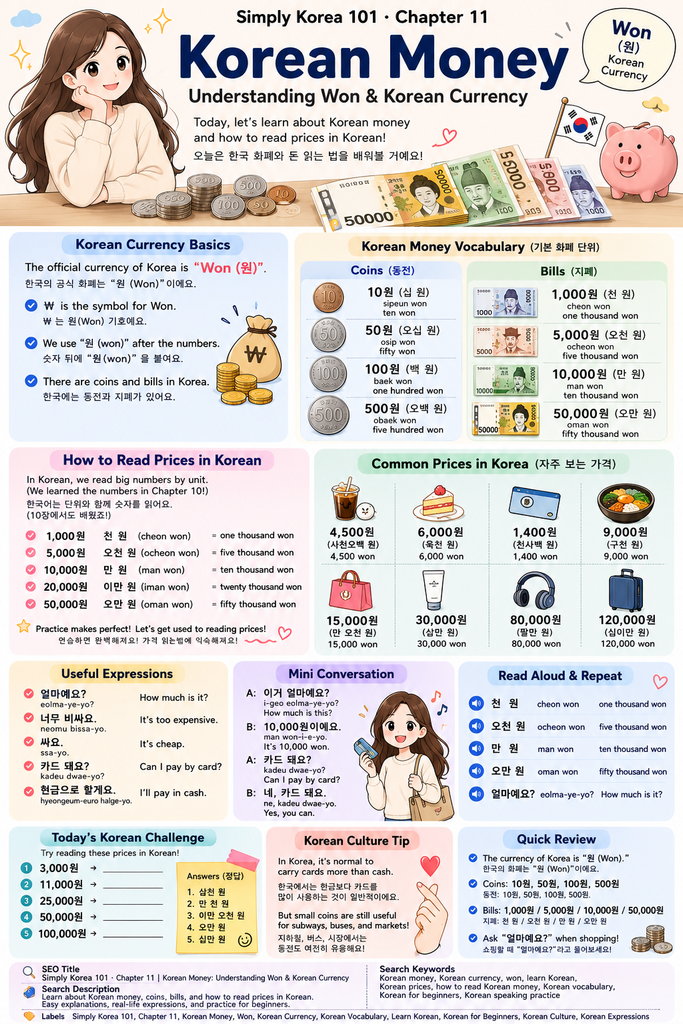
💰 1. Korean Currency Basics
The official currency of South Korea is the Korean won.
The Korean word for money is:
돈
don
→ money
The basic currency unit is:
원
won
→ won / Korean currency unit
When reading a price, simply say the Sino-Korean number followed by 원 (won).
→ 가격을 읽을 때는 한자어 숫자 뒤에 원(won)을 붙이면 돼요.
For example:
1,000원 — 천 원
cheon won
→ 1,000 won
5,000원 — 오천 원
o-cheon won
→ 5,000 won
10,000원 — 만 원
man won
→ 10,000 won
🪙 2. Korean Coins
Korea currently uses four commonly circulated coin denominations.
| Coin | Korean | Pronunciation | English |
|---|---|---|---|
| 10원 | 십 원 | sip won | ten won |
| 50원 | 오십 원 | o-sip won | fifty won |
| 100원 | 백 원 | baek won | one hundred won |
| 500원 | 오백 원 | o-baek won | five hundred won |
1-won coin also exists as legal currency, but it is rarely encountered in ordinary cash transactions today.
💵 3. Korean Banknotes
There are four main banknotes you’ll commonly see in Korea.
| Banknote | Korean | Pronunciation | English |
|---|---|---|---|
| 1,000원 | 천 원 | cheon won | one thousand won |
| 5,000원 | 오천 원 | o-cheon won | five thousand won |
| 10,000원 | 만 원 | man won | ten thousand won |
| 50,000원 | 오만 원 | o-man won | fifty thousand won |
If you’re visiting Korea, 천 원, 오천 원, 만 원, 오만 원 are especially useful expressions to recognize.
🔢 4. How to Read Korean Money
Remember the Sino-Korean numbers from Chapter 10?
Here are the most important units you’ll need for reading Korean prices.
십 — sip — ten
백 — baek — hundred
천 — cheon — thousand
만 — man — ten thousand
The most important one to remember is 만 (man).
In Korean, 10,000 is expressed as one 만, so larger prices are often grouped around 만.
Let’s read some real prices!
1,000원 — 천 원
cheon won
→ 1,000 won
3,500원 — 삼천오백 원
sam-cheon-o-baek won
→ 3,500 won
5,300원 — 오천삼백 원
o-cheon-sam-baek won
→ 5,300 won
12,000원 — 만 이천 원
man i-cheon won
→ 12,000 won
25,700원 — 이만 오천칠백 원
i-man o-cheon-chil-baek won
→ 25,700 won
50,000원 — 오만 원
o-man won
→ 50,000 won
100,000원 — 십만 원
sip-man won
→ 100,000 won
💡 Tip
Unlike English, Korean has a special unit for 10,000: 만 (man).
Once you get comfortable with 만, reading Korean prices becomes much easier.
🛍️ 5. Five Useful Expressions
Now let’s learn five expressions you can actually use while shopping in Korea.
① 얼마예요?
얼마예요?
eol-ma-ye-yo?
→ How much is it?
This is one of the most useful expressions to know when shopping in Korea.
② 이것은 얼마예요?
이것은 얼마예요?
i-geoseun eol-ma-ye-yo?
→ How much is this?
Use this when you want to ask the price of a specific item.
③ 계산해 주세요.
계산해 주세요.
gye-san-hae ju-se-yo.
→ Please ring this up. / I’d like to pay.
You can use this when you’re ready to pay at a restaurant, café, or store.
④ 카드 돼요?
카드 돼요?
ka-deu dwae-yo?
→ Can I pay by card? / Do you take cards?
This is a simple and natural way to ask whether card payment is accepted.
⑤ 영수증 주세요.
영수증 주세요.
yeong-su-jeung ju-se-yo.
→ Please give me a receipt.
Use this when you need a receipt after paying.
🗣️ 6. Mini Conversation
At a Café ☕
→ 카페에서
A: 이거 얼마예요?
i-geo eol-ma-ye-yo?
→ How much is this?
B: 4,000원이에요.
sa-cheon won-i-e-yo.
→ It’s 4,000 won.
A: 케이크는 얼마예요?
ke-i-keu-neun eol-ma-ye-yo?
→ How much is the cake?
B: 6,500원이에요.
yuk-cheon-o-baek won-i-e-yo.
→ It’s 6,500 won.
A: 카드 돼요?
ka-deu dwae-yo?
→ Can I pay by card?
B: 네, 카드 돼요.
ne, ka-deu dwae-yo.
→ Yes, you can pay by card.
A: 계산해 주세요.
gye-san-hae ju-se-yo.
→ I’d like to pay, please.
Great! You can already handle a simple payment situation in Korean.
🔊 7. Read Aloud & Repeat
Let’s practice reading Korean prices out loud.
1,000원 — 천 원
cheon won
→ one thousand won
3,200원 — 삼천이백 원
sam-cheon-i-baek won
→ three thousand two hundred won
7,800원 — 칠천팔백 원
chil-cheon-pal-baek won
→ seven thousand eight hundred won
15,000원 — 만 오천 원
man o-cheon won
→ fifteen thousand won
32,500원 — 삼만 이천오백 원
sam-man i-cheon-o-baek won
→ thirty-two thousand five hundred won
75,000원 — 칠만 오천 원
chil-man o-cheon won
→ seventy-five thousand won
100,000원 — 십만 원
sip-man won
→ one hundred thousand won
Try reading them once slowly and then one more time at a natural speed.
🎯 8. Today’s Korean Challenge
Can you read these prices in Korean?
1. 2,500원
→ __________
2. 6,700원
→ __________
3. 14,000원
→ __________
4. 28,900원
→ __________
5. 50,000원
→ __________
Answers
1. 이천오백 원
i-cheon-o-baek won
→ 2,500 won
2. 육천칠백 원
yuk-cheon-chil-baek won
→ 6,700 won
3. 만 사천 원
man sa-cheon won
→ 14,000 won
4. 이만 팔천구백 원
i-man pal-cheon-gu-baek won
→ 28,900 won
5. 오만 원
o-man won
→ 50,000 won
How many did you get right?
If 만 (man) still feels unfamiliar, that’s completely normal.
The more Korean prices you see, the more natural it will become.
9. Korean Culture Tip
[확실] Cards and mobile payments are widely used in everyday life in South Korea, so travelers don’t necessarily need to carry large amounts of cash.
However, carrying a small amount of cash can still be useful in certain situations.
And here’s another useful cultural detail: when Koreans give money for occasions such as weddings, the money is traditionally placed inside an envelope.
So understanding Korean money isn’t just useful for shopping—it also helps you understand everyday Korean culture.
✨ 10. Quick Review
Today, we learned how Korean money works.
Korean currency: 원 (won)
→ 한국의 화폐 단위: 원
Money: 돈 (don)
→ 돈
Coins: 10원, 50원, 100원, 500원
→ 동전: 십 원, 오십 원, 백 원, 오백 원
Banknotes: 1,000원, 5,000원, 10,000원, 50,000원
→ 지폐: 천 원, 오천 원, 만 원, 오만 원
We also learned that Korean money uses Sino-Korean numbers.
And now you can ask:
얼마예요?
eol-ma-ye-yo?
→ How much is it?
Next time you see a Korean price, try reading it aloud before checking the answer.
💛 See You in the Next Chapter!
You don’t have to learn everything at once.
Just learn one word, one phrase, and one step at a time.
Keep practicing, and you’ll be surprised how much Korean you can understand.
See you in the next chapter!
— Ayla
Let’s discover Korea, one word, one dish, and one story at a time.